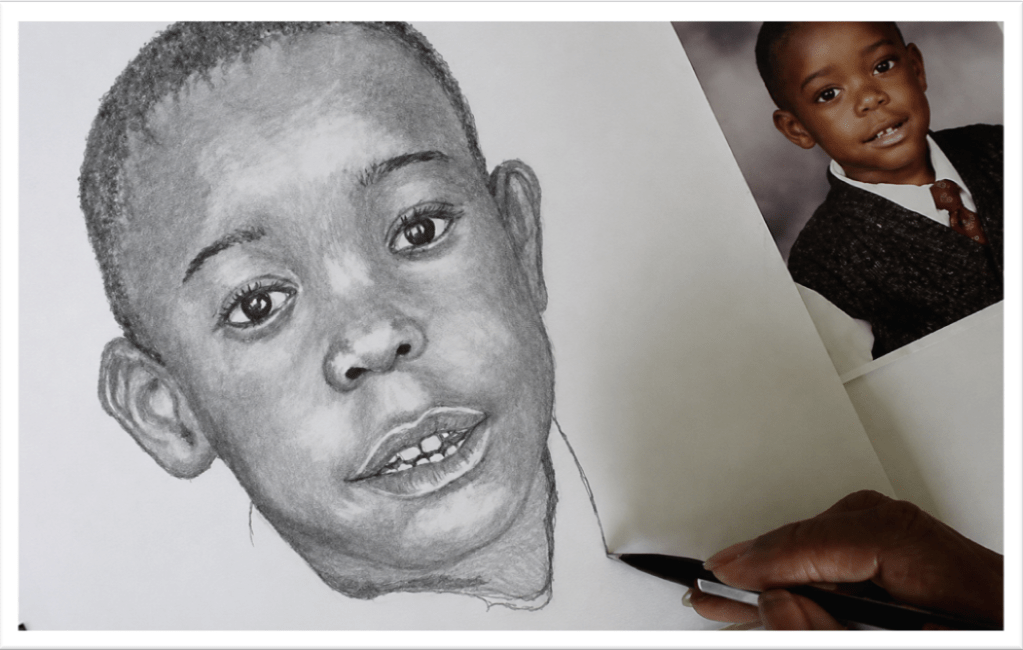
This little guy is only three years old in this drawing. Right now, he is busy discovering the world around him. He has no idea that someone has spent hours carefully studying his face, noticing the sparkle in his eyes, the shape of his smile, and the little details that make this season of his life unique.
One day, that will change. One day, he will receive this portrait.
When that day comes, I hope he sees more than a drawing. I hope he sees that someone believed his childhood was worth preserving. I hope he realizes that every pencil stroke was placed with care because he was deeply loved.
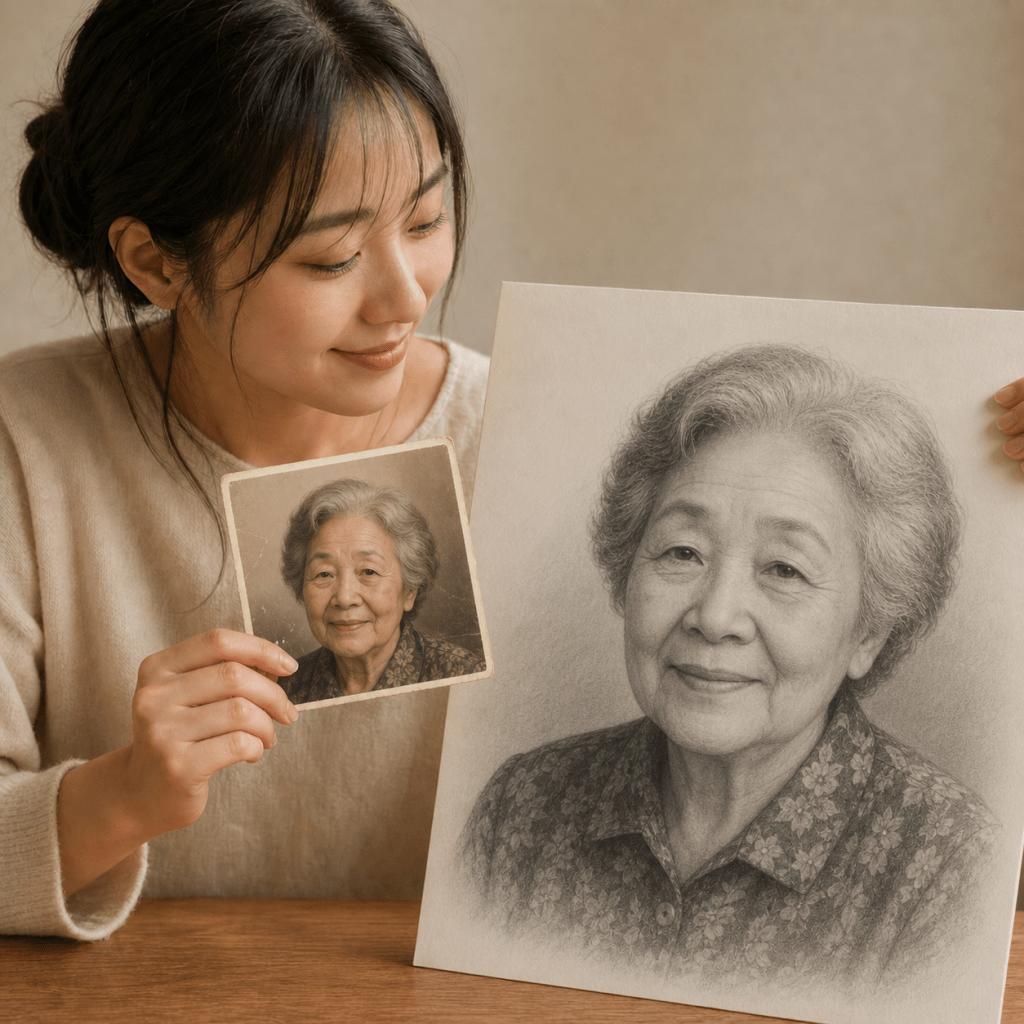
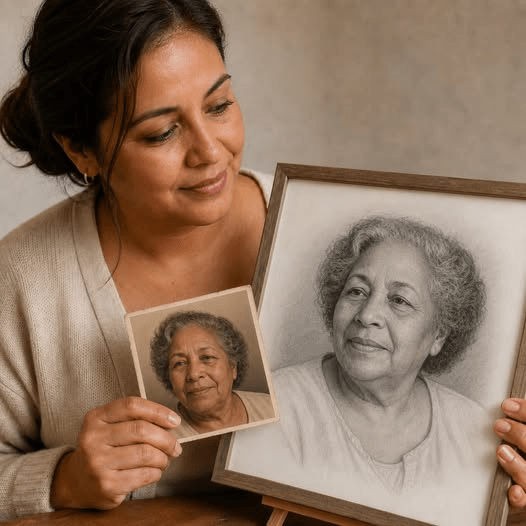
Photographs help us remember what someone looked like. A hand-drawn portrait tells a different story. It reminds us that someone slowed down long enough to truly see us.
As I worked on this portrait, I found myself thinking about the many moments that make childhood so precious. At three years old, life is full of curiosity, wonder, and endless possibilities. Those moments pass quickly, but they do not have to be forgotten.
This is what makes a personal heirloom portrait so meaningful. It preserves more than a face. It preserves a season of life that can never be lived again.
And perhaps, years from now, when this young man holds this drawing in his hands, he will know that before he was old enough to appreciate it, someone loved him enough to preserve this moment just for him. Because every portrait begins with someone you love.
If there is a season of someone’s life that you wish could be held onto just a little longer, who would you choose to draw?
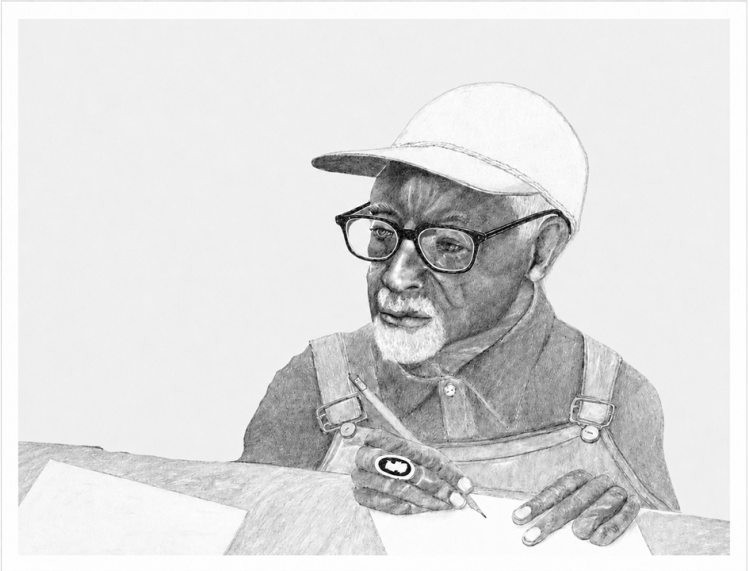
When I was growing up, my grandfather taught me that it is never too late to learn.
One summer morning, we were walking together when he proudly told me that he had learned to read and write. I still remember the smile on his face. It was not just the smile of a man who had learned a new skill. It was the smile of a man who had opened a new chapter in his life.
That moment stayed with me.
My grandfather was born in Mississippi during a time when the United States was still segregated. As a child, he worked in the fields instead of going to school. He did not have the same chance to learn to read that many people take for granted.
But his story did not end in the field.
When he was in his 80s, he learned to read.
After he passed away, our family found a newspaper article among his belongings. The headline read, “Mr. Dan Learns to Read.”
Seeing that headline brought me back to that summer morning. It reminded me of his pride, his courage, and his willingness to keep becoming, even late in life.
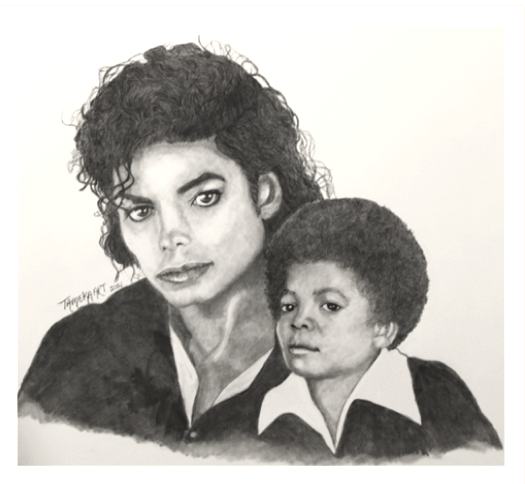
17 years ago today, the world lost Michael Jackson.
Some artists entertain us. Some artists inspire us. A rare few change the way the world experiences music. Michael Jackson was one of those artists.
His music crossed generations, cultures, and borders. Whether you grew up listening to the Jackson 5, Thriller, Bad, Dangerous, or HIStory, there is a good chance one of his songs became part of your own story. As an artist, I wanted to honor both the child who first stepped onto the stage and the man who became one of the greatest entertainers the world has ever known.
Thank you, Michael, for reminding us that dedication, imagination, and creativity have the power to leave a legacy that lives far beyond our lifetime.
Your music continues to inspire. Your artistry continues to influence. Your legacy continues to live on.
Life became busy. Somewhere between school, work, and endless to-do lists, you stopped drawing. The decision did not come from a lack of talent. It happened quietly, as other responsibilities started to feel more urgent and more important.
This course is a gentle way back to that creative part of you.
Believe Like a Child; Draw Like an Artist is a self-paced online drawing course for adults and teens who want to start, or restart, drawing in a way that feels calm, encouraging, and manageable. The lessons rebuild your skills from the ground up with simple tools: lines, shapes, light, and space. At the same time, the practice of drawing gives your mind something it rarely receives in modern life: quiet, focused time to create.
Drawing becomes more than a skill. It becomes a small, steady ritual that feels almost therapeutic.
When you sit down to draw, you give yourself permission to:
slow down and breathe, one line at a time
feel grounded and present, instead of scattered and rushed
reconnect with the version of yourself that believed you could draw
As you move through the course, you do not guess and hope that a drawing “turns out.” You follow a clear, step-by-step system that makes drawing feel understandable and repeatable.
You will learn how to:
Use the grid method to train your eyes and place lines accurately, so proportions stop feeling like guesswork.
Practice line control and line weight to show form, value, and feeling with confidence.
Build any subject from basic shapes, which gives your drawings solid structure and balance.
Use positive and negative space to check accuracy and correct mistakes in a calm and encouraging way.
Bring everything together with simple 3D forms, light direction, shadows, and one-point perspective, so your drawings look solid and believable.
Each lesson includes:
clear, beginner-friendly instruction in everyday language
guided steps that train you to “see like an artist,” so you know what to look for on the page
short practice options (5, 15, and 30 minutes) that fit a busy life
small, confidence-building tasks that help you notice progress early and often
Over time, this course can feel like a form of gentle art therapy. When you draw, your breathing slows, your attention narrows, and your mind receives a break from constant noise and distraction. You express thoughts and feelings that do not always come out in words. You create something that exists purely because you chose to make it.
By the end of the course, you finish with more than a handful of drawings. You finish with a repeatable process that you can return to whenever you want to feel calmer, more focused, and creatively alive.
If any part of you still believes that you can draw, Believe Like a Child; Draw Like an Artist is here to prove that part right.
Stay in the Driver Seat: How to Work with AI Without Losing Your Voice
AI can be useful. AI can also be loud. If you are not careful, the tool can start steering your message. That is why the most important skill with AI is not “prompting.” The most important skill is staying true to yourself while you use it. You are not a passenger in an AI conversation. You are the starter, the guide, and the final editor.
AI is a Tool, not a Truth Machine
AI predicts words. It does not “know” your life, your values, or your intentions unless you teach it. Even then, it can still guess wrong. So, you must treat AI like a helper in your studio.
A helper can offer options.
A helper can save you time.
A helper cannot replace your judgment.
Original drawing
You are the Generator of the Conversation
AI does not wake up and decide what you should say. You decide the goal, the tone, and the limits. If you want the final message to sound like you, then you must stay involved in the process. This means you do not just accept the first answer. You question it. You shape it. You correct it.
You are Responsible for Authorizing the Result
This part matters. Even when AI gives you “a great answer,” you are still the one who posts it, shares it, sends it, or publishes it. This means you own the outcome. Before you use any AI output, ask:
Is this true?
Is this clear?
Does this match my values?
Does this sound like me?
Would I say this out loud to a real person?
If the answer is no, revise it. If the answer is “I am not sure,” verify it.
A Real Example from My Art Process
In my short video, you can see what I mean.
From drawing to AI generated
The clip shifts from a graphite drawing to a full-color image with a peaceful lake and mountain scene. The result still feels connected to the artist’s hand, not like a random image that replaced my work. This result happened because I stayed involved. I wrote prompts that told AI what I wanted generated even down to the background scenery. I did not allow AI to take over and replace my work. I used my original drawing to guide the result. AI was treated like a tool that could support my vision, not a tool that could erase it. My point is this: AI can assist your message, but it should not steal your message.
How to Ask Better AI Questions so You Stay in Control
Many people get weak answers because they ask weak questions. They say, “Write a blog post about AI,” and the tool fills in the blanks with guesses. Try this process instead.
1) Start with your intention
Write one sentence first:
“I want to encourage readers to stay true to themselves while using AI.”
That sentence is your anchor. Return to it every time the tool drifts.
2) Give AI a role
Roles help AI stay focused:
“Act like a writing coach. Ask me questions before you write.”
“Act like an editor. Fix clarity and keep my tone.”
3) Set guardrails
Guardrails protect your voice:
“Do not add facts I did not give you.”
“Use simple language.”
“Keep the tone encouraging and honest.”
“If something is unclear, ask me.”
4) Ask for options, not one answer
Options keep you in charge:
“Give me 5 headline options.”
“Give me 3 openings with different moods.”
“Give me 2 endings: one short, one emotional.”
How to Push Back When AI Is Unclear
Pushing back is not rude. It is responsible. Use direct sentences like these:
“That is unclear. Rewrite it in simpler words.”
“List your assumptions in bullet points.”
“Ask me 3 questions before you continue.”
“Give me an example and a non-example.”
“Show me the steps you used to reach this conclusion.”
“Remove any claims you cannot support with evidence.”
“That does not sound like me. Rewrite it in my voice.”
If the draft still feels fuzzy, the problem is not you. The problem is the draft. Keep editing.
A Simple “AI Integrity Checklist” Before You Publish
Run this checklist every time:
Truth: I can stand behind every claim.
Voice: This sounds like me, not like a generic internet post.
Clarity: A 14-year-old can understand it.
Purpose: This supports my real intention.
Responsibility: I reviewed it and approved it on purpose.
Final Thought: Stay Involved with Your Message
AI can help you move faster, but speed is not the goal. Trust is the goal. Integrity is the goal. Your voice is the goal. Stay in the driver seat. Let AI assist your process but let your values lead the work.
Over the past several days, we have talked about belief, permission, ability versus skill, starting small, and practicing without pressure. Today, I want to focus on what naturally grows when you keep showing up. Confidence.
Confidence does not appear all at once. Confidence is built quietly through repetition. Each time you practice, your eyes learn more. Your hands feel steadier. Your mind becomes calmer.
Short, regular practice sessions help your brain and hands work together. Drawing for ten minutes each day builds more confidence than drawing for one hour once a week. Consistency removes fear because your mind begins to recognize the process. The blank page no longer feels unfamiliar. The pencil feels more comfortable. You begin to trust yourself. Tools like the grid make consistency easier.
The grid gives your practice a clear starting point. You do not need to decide what to draw next. You choose one square and begin. Over time, this simple habit builds focus and control. To support your practice, I am sharing two free tools again today.
First, here is the short video that shows how to use the grid step by step. This video will help you understand how the grid trains your eyes to see shapes, spacing, and placement.
These tools are educational in nature. They do not promise artistic results or outcomes. Everyone learns at a different pace. Their purpose is to support observation, practice, and confidence.
If you have missed a day or felt discouraged, this post is your reminder that progress does not require perfection. What matters is returning to practice.
One square today builds confidence for tomorrow. Another square strengthens your ability to see and draw.
If you would like continued guidance and structured lessons that build confidence through consistency, my beginning drawing course provides step by step instruction focused on fundamentals.
Over the past few days, we have talked about belief, permission, ability versus skill, and starting small. Today, I want to focus on what helps growth to happen over time. Practice.
Many people believe that improvement comes from long sessions or perfect drawings. In reality, progress comes from consistent and gentle practice. Small actions repeated over time create real change. So, tools like the grid matter so much.
The grid helps remove pressure. It gives your eyes a place to rest and your mind a clear focus. When you work one square at a time, drawing feels less overwhelming and more manageable.
Practice does not mean rushing. Practice means showing up regularly with patience and curiosity. To help you practice with confidence, I recorded a short video that shows how to use the grid step by step. In the video, I explain how the grid helps you slow down, observe carefully, and draw what you see instead of what you think you see.
Along with the video, I am also offering a free 16-square drawing grid that you can download and print as many times as you need. This grid is meant to be used again and again as you practice.
This resource is educational in nature. It does not promise artistic results or outcomes. Everyone learns at a different pace. The purpose of the grid is to support observation, consistency, and confidence.
Here is something important to remember:
You do not need to practice perfectly. You do not need long sessions. You only need consistency.
One square today is enough. Another square tomorrow is progress.
If you would like guided lessons that build on this practice and teach the fundamentals step by step, my beginning drawing course provides clear instruction and encouragement for each stage of learning.
Over the past few days, we have talked about belief, permission, and the difference between ability and skill. Today, I want to talk about something that quietly stops many people from learning to draw. That thing is fear.
Fear often appears as hesitation. It shows up as a blank page and a pencil that never touches the paper. Fear tells us that we might fail or that our drawing might not look right.
Fear grows when the task feels too big.
One of the most helpful ways to move past fear is to start small. Artists do not begin by trying to draw everything at once. They break the image down into smaller parts. When the task becomes smaller, fear becomes quieter. This is where an important drawing tool comes in. The grid.
A grid helps you see like an artist. It divides a drawing into manageable sections so your eyes can focus on one small area at a time. Instead of worrying about the entire picture, you only focus on one square. One square feels possible. One square feels safe. One square invites action.
Using a grid teaches your eyes to notice shapes, angles, and placement. It also helps your mind slow down. Fear loses strength when your attention has a clear direction.
To support you as you begin, I am offering a free 16-square drawing grid that you can download and print as many times as you need. You may access your grid here:
This grid is designed to help you practice drawing in small, focused steps. You do not need to fill every square at once. You only need to choose one square and begin.
This free resource is educational in nature. It does not promise artistic results or outcomes. Everyone learns at a different pace. The purpose of this tool is to support observation, practice, and confidence.
If you have been feeling nervous about starting, let this post serve as your encouragement today. You do not need to be fearless. You only need to be willing to take a small step.
If you would like more guidance on how to use tools like the grid and learn the fundamentals step by step, my beginning drawing course provides clear and supportive instruction.
Fear does not disappear all at once. It fades when action begins. Start small. Choose one square. Let your pencil move. You are learning. You are growing. And you are capable.
 Tameka Art